
A Level Religious Studies (OCR)
A Level Religious Studies is a challenging and thought-provoking course that explores some of the most important philosophical, ethical and religious questions facing humanity. Students will develop a deep understanding of religious beliefs, ethical theories and philosophical arguments, while building the critical thinking and analytical skills needed for academic success and informed debate.
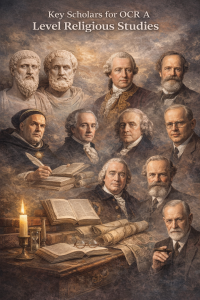
The course is divided into three main areas of study. Philosophy of Religion examines questions about the nature and existence of God, religious experience, the problem of evil, and the ways religious language is used to express beliefs. Students engage with influential thinkers such as Plato, Aristotle and Aquinas while analysing arguments about faith and reason.
In Religion and Ethics, students study key ethical theories including Natural Law, Situation Ethics, Kantian ethics and Utilitarianism. They explore how these theories apply to contemporary issues such as euthanasia, business ethics and sexual ethics, developing the ability to construct balanced arguments and evaluate different viewpoints.
The third component focuses on Developments in Religious Thought, allowing students to study one major religious tradition in depth. This includes examining beliefs, teachings, practices and the ways religion interacts with modern society and contemporary debates.
Throughout the course students learn to analyse complex ideas, evaluate scholarly perspectives and communicate their own arguments clearly. These skills make Religious Studies an excellent preparation for a wide range of university courses and careers, including law, politics, philosophy, theology, education, journalism and the social sciences.
Philosophy of Religion
- Ancient philosophical influences (Plato and Aristotle)
- Soul, mind and body
- Arguments for the existence of God
- Cosmological argument
- Teleological argument
- Ontological argument
- Religious experience
- The problem of evil and suffering
- The nature and attributes of God
- Religious language
- Symbolic language
- Analogical language
- Via negativa
- Twentieth-century perspectives (verification, falsification, language games)
Religion and Ethics
- Natural Law (Aquinas)
- Situation Ethics (Fletcher)
- Kantian ethics
- Utilitarianism (Bentham and Mill)
- Applied ethics
- Euthanasia
- Business ethics
- Meta-ethics
- Naturalism
- Intuitionism
- Emotivism
- Conscience
- Aquinas’ view
- Freud’s psychological view
- Sexual ethics
- Premarital and extramarital sex
- Homosexuality
Developments in Religious Thought (Christianity)
- Augustine’s teaching on human nature
- Death and the afterlife
- Knowledge of God
- Natural theology
- Revealed theology
- The person of Jesus Christ
- Christian moral principles
- Christian moral action (Dietrich Bonhoeffer)
- Pluralism and theology
- Gender and feminist theology
- Secularism and the challenge of modern society
Results
- 2025 – ALPS 6 – 83% A* – C
- 2024- ALPS 6 – 75% A* – C
- 2023 – ALPS 2 – 100% A* – C
- 2022 – ALPS 2 – 100% A* – C
- 2019 – ALPS 3 – 92% A*-C
- 2018 – ALPS 8 – 56% A*-C
- 2017 – ALPS 4 – 77% A*-C
See resources on RE Dept Website
